
CHEM 505 -
Forensic Analytical Chemistry
Section 001, Course # 11940, 3.0 Credit Hrs - Fall 2026
Time/Location: 12:30 - 1:45 TR / Sims 113B
Professor: Dr.
Cliff Calloway, callowayc@winthrop.edu
Office/Phone:
312-B Sims Science Building/323-4945
Office Hours: MTR: 10:00-12:00 {Other times and modes, too....please don't hesitate to contact me.}
Textbook reommended: Saferstein, R. Criminalistics, 13th
ed., 2022.
An older edition is okay. It would also be a good
idea to have an organic and quantitative analysis (or instrumental analysis)
textbook handy.
Pre-requisites: Grade
of C or better in Chem 313 and 314
Co-requisite: Chem 506
Registration
Calendar (important dates for
registration, S/U, graduation, etc.)
Introduction:
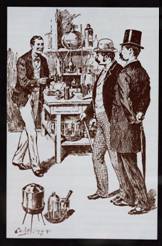
"This was a lofty chamber, lined and littered with countless bottles. Broad, low tables were scattered about, which bristled with retorts, test-tubes, and little Bunsen lamps, with their blue flickering flames. There was only one student in the room, who was bending over a distant table absorbed in his work. At the sound of our steps he glanced round and sprang to his feet with a cry of pleasure. 'I've found it! I've found it,' he shouted to my companion, running towards us with a test-tube in his hand. 'I have found a re-agent which is precipitated by hemoglobin, and by nothing else.' Had he discovered a gold mine, greater delight could not have shone upon his features. 'Dr. Watson, Mr. Sherlock Holmes,' said Stamford, introducing us."
- Sir Arthur Conan Doyle, A Study in Scarlet, 1887
 Copyright:
National Library of Medicine
Copyright:
National Library of Medicine
Course Goals:
Forensic Science plays a critical role in our society and public intrigue has certainly increased with the popularity of several recent television shows. You will see that Forensic Science is a broad, interdisciplinary subject. In its broadest context, forensic science can be thought of as the application of scientific principles to all matters of the law. This can include criminal or civil procedures. In this course, we will be concerned with criminal justice aspects. However, even in this context, consider the scope..biochemical applications to bloodstain analysis or the examination of other body fluids. Knowledge of biology would be required for the examination of human tissues, physiological fluids, pollen, and leaves. Physics is often used in crime scene reconstruction..velocity analysis and metrology to determine the amount and/or direction of force. Materials science is needed during the examination of concrete, paint, glass, dyes, and ceramics. Anthropology relates to the examination of bone, teeth, bite marks, and hair. Mathematics, statistics and probability are important when considering the frequency of occurrence of artifacts and distribution patterns. Geology and microscopy are other important disciplines used in the forensic sciences.
"Forensic Chemistry" would then be the
application of chemistry and chemical principles to matters of the law.
Winthrop University's faculty adopted a set of four University Level Competencies (ULCs) that describe the qualities our students develop during their Winthrop career. It is easy to see that this course involves solving problems and developing written communication skills. However, you will also learn the responsibilities of chemists to the greater good of our planet and society, as well as the global nature of the chemistry enterprise. Within the discussions of chemical analysis instrument design and applications to forensics, I think you will find this course fits well with all four competencies.
Competency 1:Winthrop graduates think critically and solve problems.
Winthrop University graduates reason logically, evaluate and use evidence, and solve problems. They seek out and assess relevant information from multiple viewpoints to form well-reasoned conclusions. Winthrop graduates consider the full context and consequences of their decisions and continually reexamine their own critical thinking process, including the strengths and weaknesses of their arguments.
You will be using sophisticated mathematical and descriptive methods to solve problems found in environmental, pharmaceutical, biomedical, energy, food, forensic and electronic fields, for example.
Competency 2:Winthrop graduates are personally and socially responsible.
Winthrop University graduates value integrity, perceive moral dimensions, and achieve excellence. They take seriously the perspectives of others, practice ethical reasoning, and reflect on experiences. Winthrop graduates have a sense of responsibility to the broader community and contribute to the greater good.
Chemistry touches 95% of everything we use daily. Chemists need to be critically aware of industry impacts on the environment and human health.
Competency 3:Winthrop graduates understand the interconnected nature of the world and the time in which they live.
Winthrop University graduates comprehend the historical, social, and global contexts of their disciplines and their lives. They also recognize how their chosen area of study is inextricably linked to other fields. Winthrop graduates collaborate with members of diverse academic, professional, and cultural communities as informed and engaged citizens.
Chemistry is a global enterprise with many industries located around the world that impact our quality of life. Chemistry is a core topic, touching most fields of interest from science, to art, to technology.
Competency 4:Winthrop graduates communicate effectively.
Winthrop University graduates communicate in a manner appropriate to the subject, occasion, and audience. They create texts - including but not limited to written, oral, and visual presentations - that convey content effectively. Mindful of their voice and the impact of their communication, Winthrop graduates successfully express and exchange ideas.
Science, in general, is difficult to understand, so correct, clear and effective communication methods are key. Peer review is fundamental to scientific communications.
Student Learning
Outcomes:
By the end of this
course, you should:
- Have
an understanding of broad areas of forensic science and more specifically,
criminalistics
- Understand
how analytical chemistry and forensics complement each other as well as
the differences in strategies
- Understand
the unique circumstances of forensic samples and preparation
- Have a broad knowledge of the types of instrumentation generally available and the information provided by each, including methods admissible in court
- Understand
the advantages, disadvantages, and limitations of different instruments used
for similar types of analyses
- Have
a broad knowledge of the analysis of drugs, combustion, firearms, and
polymers.
Course Requirements:
Student
Conduct Code: "Responsibility for good conduct rests with students as adult
individuals." Refer to the "Academic Misconduct Policy" in the online Student Handbook:
https://www.winthrop.edu/studentconduct/winthrop-university-student-handbook.aspx
Grades in this course will be determined
from three sources, as follows:
- Homework (30%): Periodically, homework
problems will be assigned as handouts, or in-class.
Due dates for each assignment are the final date each assignment will be
accepted. Your lowest homework
assignment will be dropped before averaging.
- Mid-term Exams
(50%): There will be 3 exams given during the term covering the topics
listed below. Make sure to bring pencil and scientific calculator to the
exam. Cell phone calculators are
not allowed. Make-up exams are not usually given except under extreme circumstances. If you plan to miss an exam with valid
excuse, let me know as soon as possible. The exams are scheduled as follows:
- Exam 1: September 24
- Exam 2: October 22
- Exam 3: December 1
- Cumulative Final
Examination (20%): Thursday, December 10, 11:30 am. If you
score higher on the final exam than your lowest mid-term exam, the final
exam grade will replace the lowest exam grade, before averaging.
Letter grades will
be assigned as follows:
|
94
- 100%: |
A |
90-93%: |
A- |
86-89%: |
B+ |
82-85%: |
B |
78-81%: |
B- |
|
74-77%: |
C+ |
70-73%: |
C |
66-69%: |
C- |
62-65%: |
D+ |
58-61%: |
D |
|
55-57%: |
D- |
|
|
|
|
|
|
|
|
Attendance:
You are expected to attend each class meeting
for the full scheduled time. This is a
difficult upper-level course and attendance will help you
concentrate on the appropriate material and reinforce the assigned readings and
problems. You are required to bring
pencil, paper and a scientific calculator to each class. Cell phone calculators are not acceptable.
Accessibility:
Winthrop
University is dedicated to providing access to education. If you have a condition which may adversely impact your ability to access academics and/or campus life, and you require
specific accommodations to complete this course, contact
the Office of Accessibility (OA) at 803-323-3290, or,
accessibility@winthrop.edu, as early as possible
to discuss your concerns.
Additional Requirements for Graduate Level
Credit:
Students
wishing to receive graduate level credit for this course are required to
complete a 5-7 page review paper on a cutting edge analytical technique applied
to criminialistics. Resources can be found by reviewing either
the "Fundamentals Review" or "Applications Review" issues of the journal, Analytical Chemistry (June 15th
issue of even & odd years, respectively). The paper must cite a minimum of 10 primary literature sources and must
be submitted by December 6, 2018. Graduate students should be aware that Winthrop's +/- grading system is
not applicable to courses taken for graduate credit. Letter grades will be assigned as follows:
92%-100% A; 83%-91% B; 74%-82% C, 55%-73% D.
Syllabus Changes:
While unlikely, the Professor
reserves the right to change the course syllabus if circumstances dictate. You will be notified of any change via class
meeting time and/or email.
AI Statement:
You are welcome to and encouraged to use AI technology as appropriate, outside of class time. Be cautious of the results. If you do use AI, please add a note indicating which AI program you used and date used.
Course Calendar:
|
Tentative
Schedule*: |
|
|
|
|
Date |
|
Lecture Sections |
|
|
T,
25-August
|
|
Introduction
|
Overview |
|
R,
27-August
|
|
Chapter 1_1 |
Introduction |
|
T, 1-September
|
|
Chapter
1_2 |
|
|
R, 3-September |
|
Chapter 2_1 |
The Crime Scene |
|
T, 8-September
|
|
Chapter 2_2 |
|
|
R, 10-September
|
|
Chapter
3_1 |
Physical Evidence |
|
T, 15-September
|
|
Chapter
3_2 |
|
|
R,
17-September
|
|
Chapter 4_1, Review |
|
|
T, 22-September
|
|
Chapter 4_2 |
|
|
R, 24-eptember
|
|
Exam 1 (Ch. 1-3) |
|
|
T, 29-September
|
|
Chapter 4_3 |
|
|
R, 1-October
|
|
Chapter 5_1 |
|
|
T, 6-October
|
|
Chapter 5_2 |
|
|
R, 8-October
|
|
Chapter 5_3 |
Mass Spectrometry |
|
T, 13-October
|
|
Chapter 5_4 |
|
|
R,
15-October
|
|
Chapter 5_5, Review |
|
|
T, 20-October
|
|
|
|
|
R, 22-October
|
|
Exam 2 (Ch. 4-5) |
|
|
T,
27-October
|
|
Chapter 6_2 |
|
|
R,
29-October
|
|
Chapter 6_3 |
|
|
T, 3-November
|
|
Chapter 7_1 |
|
|
R, 5-November
|
|
Chapter 7_2 |
|
|
T, 10-November
|
|
Chapter 7_3 |
|
|
R, 12-November
|
|
Chapter 8_1 |
|
|
T,
17-November
|
|
Chapter 8_2 |
|
|
R,
19-November
|
|
|
|
|
T, 24-November
|
|
|
|
|
R, 26-November
|
|
No Class |
|
|
T, 1-December
|
|
Exam 3 (Ch. 6-8) |
|
|
R, 3-December
|
|
|
|
|
T, 8-December
|
|
Study Day |
|
|
R, 10-December
|
|
Final Exam; 11:30
|
|
*Schedule
is subject to change, if weather or events make it necessary.
Menu of Topics:
-
Forensic
Science Overview, Quality Control
-
The Crime Scene - Sample
Collection & Preparation
- Physical Evidence
Exam
1
- Physical Properties
- Separations and Mass Spectrometry
Exam 2
- Illicit Drugs
- Combustion
- Firearms
& Explosives
Exam 3